 There are some things in life one never really appreciates properly until they are gone.
Growing up around London, airspace was singularly busy. While others love the tranquil peace of a clear sky, home to me was Concorde, on its way to New York, 11am prompt every day.
My sky was always criss-crossed with the vapour trail of something that seated hundreds.
I still love the clear days, when we are on Heathrow’s flight path. I look up and it is a geometric masterpiece, sketched out in whispy white vapour across a skyscape.
And the sound: I have always loved waking to that first shuddering, tremoring engine of the morning. It’s normally about 6am. Some gargantuan bucket flight takes the early risers half way across the world, and there I am, in my house down below, lighting their way with a tiny pinpoint, the reality of which they can hardly conceive.
I feel as if I am really at the party, part of the drama of travel all over the world.
We moved to Kent and the airspace was busy, but with smaller planes from the myriad private airports that pepper the land.
And to our charmed delight, the skies hosted another wonder: hot air balloons.
Just a mile from our house, right across the fragrant green hop fields, was one of the big ballooning centres of the south.
Every now and then they would have a huge balloonathon, and the sky was filled with these silent bulb-giants, soundless except for the occasional gas-roar. They were always brash and brightly coloured and simply beautiful.
Every now and then, one would swoop low as it came over the house and we fleetingly wondered whether it might land, right there and then.
And once, we were so sure it would land that we ran out of the house, down the local street as the great bulb with its wicker basket dipped lower, and lower, towards the houses.
It drew us to the park, and deposited its load.
We stood, breathless, hearts hammering, amazed that something up there could land down here. It was vast, close up, dwarfing the little landrover full of arrogant people who knew all there was to know about balloons.
We were unashamedly, unaffectedly delighted, and we milled around to watch the balloon deflate, and show our friends from the landrover just how special we considered this whole landing business to be.
Not long afterwards, we upped sticks and moved to Cornwall. I found a headship in a fishing village and was totally caught up in all that might entail. For this, we thought, we can leave the skies. We shall have the sea, and we shall possess the end of the world. What more could we want?
But I confess, I missed the action in the skies. I had never known air which was clear of flying craft of some kind, and I found the empty acres of atmosphere desolate.
There was one tiny shuttle: it belonged to a company called Bryman Airways. When I sat at my sister-in-law’s house on the edge of Bodmin Moor, we would have coffee in the garden, and look up to watch this one event, a small tin cigar with wings passing over, and I would yearn.
I got a second chance: I moved back to my London skies. And I adore my busy heavens more than ever.
Today, the news was full of something Phil and I once loved, that we can never have back.
When we lived in Kent, our playground was Hastings.
A dilapidated resort, more shabby than chique but beloved by its bohemian residents, Hastings was a fabulous new frontier to explore.
Anyone not British would have been puzzled and scandalised by the stunning Georgian facades allowed to peel and grow haggard.
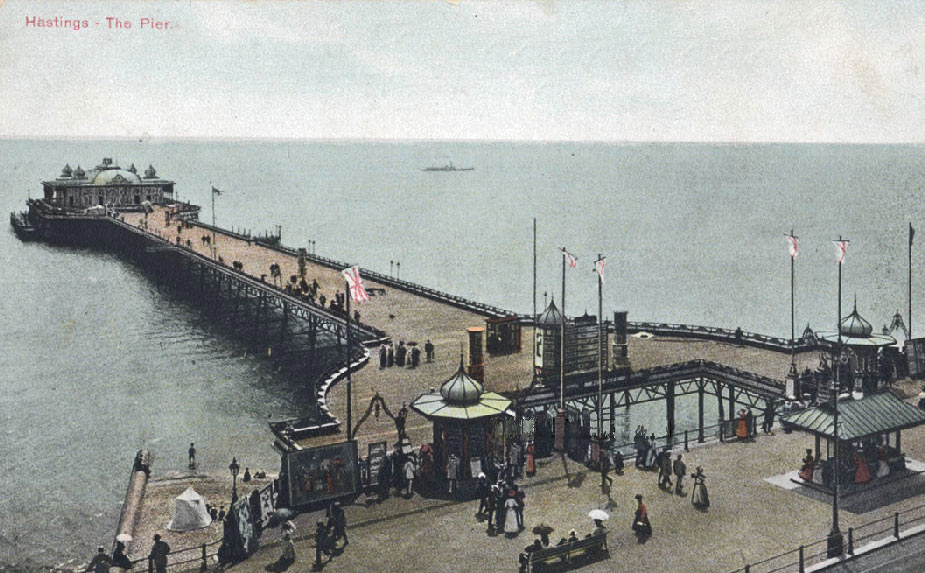
Tall pungent fish huts rose from the beach in darkened clapboard. Fish and chip shops jostled with amusement arcades and candy floss kiosks on the sea front. And foursquare on the shingle beach, standing stalwart in the waves like a stately liner setting sail, the pier dominated the skyline.
Like everything else, since its opening in 1872, it had become dusty and unkempt. But when we knew it, it still hosted many of the original amusements which had occupied Victorian and Edwardian seaside holidayers, all those years ago.
Dusty and dilapidated, they occupied us fully too. We still remember one game with affection, if a little unease: it was entitled The Mystery of The Green Light.
It would only operate with an old penny, and it hailed from the twenties, and a time when television was not something people knew a great deal about. It was just a buzz word, something to inspire awe and an irresistible urge to put a penny in the slot to see what happened.
This is what happened: you put a penny in the slot. A green light shone out of the machine, straight ahead; and you looked into it. And, using the science of television, it would read your mind. Once this miracle was performed, a small unassuming card would come out into a dish, containing your bona fide fortune.
John Logi Baird would turn in his grave. In the middle of town, at Queen’s Arcade in Hastings Town Centre, he had just a few years previously demonstrated to the Radio Times that a semi-mechanical analogue television system was possible by transmitting moving silhouette images.
Amazing, the uses to which different people put the discoveries of science.
We left the South Coast of England before the dawn of the new millennium. Six years later the pier at Hastings closed and began to deteriorate.
And so it has been doing ever since: until Monday. Because yesterday, the Hastings Pier and White Rock Trust finally invited architects to submit designs to redevelop the attraction.
It looked as though our beloved shabby pier was finally to have a renaissance.
And then, last night, the whole pier burnt down.
About 95 per cent of the upper structure, including the once gracious grand ballroom, has gone up in smoke.
There are some things in life one never really appreciates properly until they are gone.
I think we appreciated our pier while it was here: but I wish now that I had gone back, one last time, for a goodbye, before it left us forever.
 Kate Shrewsday
That one worked, Jan! Thanks!
That’s sad. I hope they will rebuild it, and make it at least look like the original – some things need to continue.
I’m sure they’ll try, Liz: and how can it fail to be a lovely space: but it won’t be the pier we all knew and loved. We haven’t been to see it for many years. I guess writing about it is as close as we’ll get to recreating it.
Oh that is sad 😦
It sure is, Cindy. Time is the one thing we can’t move heaven and earth to turn back, isn’t it?
I don’t think I have ever come across anyone who has admitted to liking the early morning alarm call of a plane going over!
Where we live we have a couple of small airfields enarby, one of which repeatedly sends up small planes at the weekend to drop out a whole swarm of parachutists. It is these small craft, flying fairly low that are a constant irritation to the ear drums on otherwise quiet weekends. The advantage of the larger craft which leave pretty trail is that they are so much higher the noise is less noticeable.
In the summer, only a few weeks ago I went out in my dressing gown to peg out some washing before work. When I looked up I saw a hot air balloon, very low in the neighbour’s field… (I think I should have tried speaking to them, they were so close!) – scaring her horses!
Poor horses, they must have thought the world was ending! It is a very strange trait, this love of large planes, I know:-) I suppose it must have been one of the sounds I heard in my cradle….
This is something I have felt of late: the grass is always greener on the other side.
Very true, Emospresso. Plenty more piers in the sea.
I didn’t mean to say that there are ‘better (greener) ones’ on the other side so take comfort, but rather, I think as humans, we will always be dissatisfied and delude ourselves to believe that better things are on the other end, so it leaves us frustrated in an unsatisfying state. We (I speak for myself, as I battle against this a lot, of late) must learn to overcome ‘the grass is always greener on the other side’ in order to be happy.
I agree, emospresso- no point convincing ourselves life is always better elsewhere- its important to value what is here with us, in the now:-) Thanks for that lovely comment.