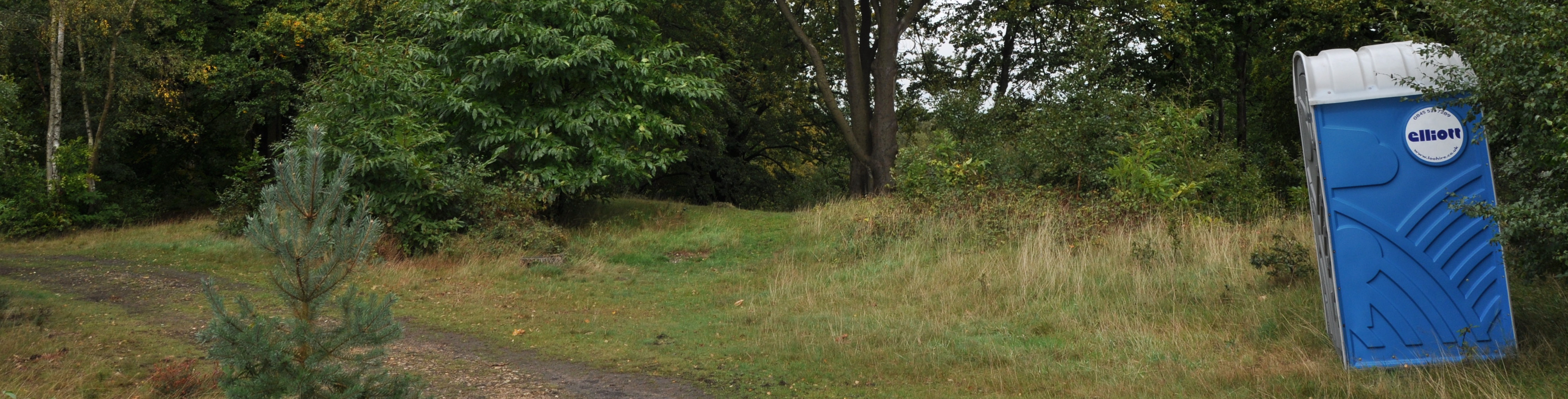
Someone appears inadvertently to have left a toilet in the forest.
It is perched on the edge of our iron age fort with a view to die for. It sits stolidly at the summit of a plummeting earthwork planted with tall beeches and hazels. It has the air of a union man.
It does not blend in: it is bright blue. It is the epitome of utilitarian practicality, though. I wonder if the workmen who have been there for a month have remembered yet that they left their toilet behind?
I can see them all, in the middle of a cup of char, just about to crank up the digger, when someone claps their hands to their forehead.
“Stone me, left the toilet behind.”
Better not have too much tea, then. And steer clear of the bran muffins.
Still, this incongruous addition to the forest has its uses. While I haven’t tried the door (yet), I can imagine it could be very useful for dog walkers and runners, caught short after stumbling out into the early morning, desperate to get in some exercise before the busy day begins.
But there is nothing pretty about it. We leave pretty and impractical to the follies.
These are buildings conceived and built in whimsy. Some authorities, including the Oxford Dictionary, have branded them the costly result of foolishness.
This morning I heard some news about a folly which is rather special to me.
My old college is housed in one of the most extravagant Georgian buildings of its time: Strawberry Hill, the frothy confection created by Horace Walpole.
Walpole was a poet, writer and MP from the top drawer of society. He was the fourth son of prime minister Sir Robert Walpole. He had spent the Summer holiday of his eighth year by the river in Twickenham, and he loved it.
At 30 years old, he realised his dream of acquiring a small house near the Thames at Strawberry Hill. And then began a life’s work to transform a small, unassuming country house into a gothic castle.
He was at the forefront of this ‘gothick’ craze of the 18th century. While reasoned liberals favoured the measured style of classicism, conservative minds looked back to mediaeval times to inspire a romanticism, and an expression of all that was great about Blighty.
Ever industrious, Walpole was not content with asking friends to advise him on this ripping new adventure.
No, he appointed a committee. It was called a ‘Committee of Taste’. It consisted of himself, John Chute – Walpole’s ‘Oracle Of Taste’, whom he met while travelling – and Richard Bentley, a skilled artist and draftsman.
This was not a scholarly trip down memory lane. It was an eclectic bag of tricks that inspired Walpole’s glorious folly.
He visited gothic buildings whenever he could. Whenever he couldn’t, he pored over books of mediaeval architecture. He sketched the details he liked, whether domestic or ecclesiastical, and then he found a way to incorporate them into his castle.
Walpole was very up-front about this. He told a friend in a letter that the rooms at Strawberry Hill were ‘more the works of fancy than of imitation.”
Thus, a gothic south front was added to the building, complete with battlements and pinnacles, clad immaculately in white plaster; a round tower was built: and inside was a feast of gothic staircases, fireplaces, stone arches, wallpaper and fretwork.
He spent £21,000 on this whimsical wonder, a fortune in the eighteenth century. The architecture of St Pancras Station and the Houses of Parliament followed where Strawberry Hill led the way. And today we have learnt that Walpole’s folly reopens very soon after a thorough restoration, which has cost of £9 million.
Walpole described the house as being made of paper and fabric. It wasn’t concieved as being a permanent gift to posterity. And yet here it is, hundreds of years later, being celebrated not in spite of, but because of its folly.
So why did he do it? Why does anyone make something pretty and foolish and expensive? A clue comes at the end of Walpole’s Parish Register of Twickenham, a list of the local VIPs. He writes: “Enough if I consign, to lasting type their notes divine: Enough, if Strawberry’s humble-hill the title page of fame shall fill.’
And there it is. The F word: fame. All is vanity, and we will go to many lengths to gain fame and occasionally notoriety. A place in the history books can be secured through gainful toil, great leadership or high birth. But a place may also be gained through other means at one’s disposal.
As Becky Sharp ably demonstrated.
She was the work of a fellow hack, William Makepiece Thackeray. This man knew what it was to skim by the seat of one’s nineteenth century britches, eking out a living by writing.
On an erudite day he might contribute to the Times: on a less august, and slightly more wicked day, it could be Punch. He said himself, he ‘wrote for his life’.
The man was incisive, and clever and occasionally merciless. In his great work, Vanity Fair, he seemed to be able to see through the surface glamour and vanity of society to the human dealings beneath.
Becky is the ultimate anti-heroine. She is clever and resourceful, with utter focus and total ruthlessness. She cares, it seems, for no-one. Her child is neglected and she treads on others to reach ever greater heights as she climbs the English social ladder.
Around her, but somehow a little less vivid, are the good guys, gentlewoman Amelia and military man Dobbin, who have built their life on solid values. They go through intense suffering as they tramp through a veritable soap opera set in the Napoleonic Wars. And Becky gets very close to the top, by championing vanity.
Vile woman, but oh, so colourful.
She uses every means in her power to court fame, using vanity. There is nothing utilitarian about her methods. In the end, the tower of notoriety she built amongst the upper classes was a tall, striking folly.
Like sugar, a little vanity goes a long way. It’s fine for building follies, but not a great foundation for a life.
Give me the honest, utilitarian comfort of a toilet in the forest any day.
 Kate Shrewsday
We saw a lorry load of them there loo’s today! B-)
Was that at the zoo? It’s amazing where you see them. Hope the workmen managed ok without theirs today:-D
No on the motorway! A portaloo on the run…….
Oh Kate, I am so glad you found my blog. How did you do that by the way? It looks as if we are both using the same wordpress template. That’s fun, too. I love your “punch lines”, your humor, your perspective. You might like to know about an online community with many members from the British Isles…all about vision…living myth and the living world. Called: http://www.mythsinger.net. Check it out when you can. Also a question. As I explore myth, I’m drawn to find ones from Europe that go far enough back they have a more indigenous perspective – a bit more balanced in terms of wild ethics and not necessarily promoting the vanquishing of the enemy or cutting off the foes head. Especially interested in ones that might speak to the power of the moon and balance between/kinship between sun and moon. I really liked the folktale/myth you shared here about collaboration among cohorts with different gifts. YES! Thank you for participating in these ethers. I have much to learn! Deborah
Thanks Deborah, I lurk like a pike at the bottom of the WordPress posts- you know- the ones just published on the dashboard. I have found some amazing writers that way, some of whom I visit daily. And I just loved yours. I don’t go for the most popular ones because they are not generally what I enjoy.
This version of the fairy tale from the Vision post comes from the Oxford Treasury of Fairy Tales,written by Geraldine McCaughrean, and I read it to my son when he was younger. I’m following a hunch that it’s Eastern European. It has that cutthroat feel about it, and the wizard’s name has a ring of that part of the world.
Strawberry Hill via a portable bog; your mind does amaze me, Kate.
I confess – shy, but safely across the pond – a fascinated fondness with follies 🙂
I think this post-modern world is a little tired of being sensible, Cindy, and follies do add a certain something to life. Which is why, I assume, £9 million was considered a worthwhile sum to spend…
‘for’ follies …
Quite. Isn’t it infuriating not being able to edit one’s comments on other sites? The number of times I get carried away and misprint. Or simply want to take it all back:-)
Hi Kate.
I should worry about trying the door of that toilet.
There might be a workman still sitting on it.
Dad
😀 Good news about Strawberry Hill though isn’t it? You and Mum fancy coming along to see it?
Are you sure it’s a toilet? Maybe the Doctor got a TARDIS upgrade.
I enjoy your blogs a lot. There’s a gentleness about them I like.
I’ll give the toilet a knock tomorrow morning to check.
It’ll be worth doing just to see the looks on the faces of passing dog walkers.
Glad you like them James, it takes real hard core bloggers to wade through more than 1000 words a day. I used to be brief, once.
And of course, it goes without saying that Aardvarkian rocks. (Using my childrens slang again…)
At present there’s a building site I can see from my window. I noted their portaloo is of superior quality to most, and quite discreet. Tucked between the row of prefabricated offices, it is the one with a little chimney – possibly a vent for the bran muffin munchers.
😀 Well as you can see, ours has no such modern convenience! What a small thing to add, and yet how deeply civilised….someone knows the true value, of good old plain fresh air….
Very funny
Cheers Dig