Is saying sorry ever easy?
Not for my son, for whom learning to say this word in the right way, and at the right time, sometimes seems to be his life’s work.
Felix is admirable in so many ways. He is an honourable young man. He is true to his word. He is clever, intuitive, thoughtful and reflective. Most important, he is kind.
He is also young and brash, and full of that assured arrogance which comes of having lived just seven years without notable experience of failure.
At least five times a day, Sorry becomes a regrettable necessity.
About six months ago, I walked into the sitting room for tidy up time. I surveyed the room, and pronounced to both Maddie and Felix that their playthings must be cleared.
Maddie, wisely, jumped to it. She immediately set about putting Barbies in the Barbie box and posting dolls house furniture into its corresponding room.
Conversely, Felix’s face crumpled like a prune, and he protested in a whining monotone that he was tired, it was the end of the day, life was hard.
I selected my Julie Andrews matronly nanny expression. And then I began.
“Felix”, I said. “Mummy works hard all day, every day from six o’clock in the morning until eight o’lock at night, looking after you, making sure you have everything for school, cooking your dinner, reading you stories. Whose job is it to tidy up this room?”
Felix didn’t even pause for thought. He simply exploded, the next rumble in an ongoing thunderstorm: “Yours!”
A sharp intake of breath from Maddie, and, yes, I would swear the dog also. These were near-suicidal tactics that Felix was adopting. His style of combat was bold, but totally unconsidered.
However, all was not lost. I am nothing if not fair.
“Felix, I want you to think extremely carefully about what you say next. Whose job is it to tidy up this room?”
His eyes rose to look at the ceiling as he riffled through the filing cabinets of his mind. He gave the best enactment of Giving This Matter Due Consideration that I have seen in a long time. Kennedy did not give more thought to sending men to the moon than my son gave to my query.
And then his eyes returned to mine. It is always good to double check, his firmness of glance informed me, and he said: “No-I’m quite sure: it’s yours.”
If you have ever been a child who had a mother, you will know the seismic activity that can result from such a proclamation.
And it did. Time-shift, if you will, to two minutes later, when a tearful boy, sufficiently humbled, was regretting his former certainty.
Reparation was inevitable. Maddie was dispatched upstairs to relax and watch television, while Felix finished the arduous tidying-up process himself, being frogmarched from task to task with boot-camp severity.
The Sorry came, of course, and whenever it does, it is so genuine that it breaks my heart. Because, while its root does include regret for his actions, Felix is really just very eager to be friends again.
When he was a little boy, Phil hated conflict. Telling him off was occasionally a necessity, and he was devastated when it happened. So his mother would draw a line underneath: she would say: “We’ll forget about it now.”
And before long, a little Phil would take this closure upon himself. He would pipe up, at the end of a reprimand: “Shall we forget about it now?”
Which they always, duly, did.
It has become an important phrase for our family. After sorry, after a little reparation, it’s important to put an end to it, to know that whatever happened is behind us now, and we look forward.
Today marks the end of a long and dramatic twentieth century story of looking backwards: of reparation.
Because on this day the last payment in a monstrous debt, odious to both debtor and collector, was paid.
Most of us have read of it in the news today: but let’s just peer down the 20th century, across one world war, to the inglorious end of another.
1919: and Germany had lost the War To End All Wars. An exhausted, shell-shocked world was reeling at the extent of the devastation it had caused. And someone must pay.
Winner took all, as usual. The winners in this case were France, Britain, the United States, Italy and Japan. Italy’s Vittorio Orlando took himself out of the Paris talks over a territorial dispute: and Japan left to make matters simpler.
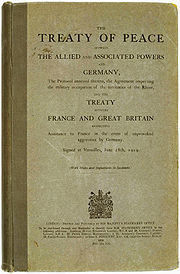
The remaining heads of state devised a treaty which stated Germany carried the guilt for causing this cataclysmic war.
That old Weimar Republic was stripped of 13 per cent of its land, and ordered to pay 269 billion gold marks.
Such crippling, uncompromising reparation is thought to have fuelled the rise of Adolf Hitler.
A twist of historical fate at the close of the second world war put the debt on hold. How can Germany say sorry, the argument went, if there are two Germanys?
Neither East nor West Germany could be expected to foot the bill on its own.
And so, like so much in that most chilly of wars, the debt froze, waiting for the Sleeping Beauty to awake.
No-one thought the wall would ever come down. They thought they had waved goodbye, once and for all, to a unified Germany: and reparation was just a piece of historical trivia used to amuse and entertain.
Where were you when the sleeping beauty woke? I watched the television on November 9th 1989, incredulous but jubilant. We were in changing times, we thought, and crowds cheered as the Berlin Wall crashed down.
It had been a cruel instrument of division.
This was an apology of the most graphic kind. It was not an apology of words. It did not need them. It was a powerful symbol of retraction. We don’t believe in this any more, it said. Let’s vanquish it.
And as Beauty awoke, her debts arose to greet her. The payments began once more.
Today, the final installment of £60 million was paid. France and her allies of the time have been repaid, and France has long since been rebuilt.
Forgetting about it should never be an option, when so much beloved young life was lost, and for what?
But a line has been drawn. Time to look to the future.
 Kate Shrewsday
What a satisfying story, Kate. Thank you. One of your gifts is how you weave the everyday story into and through the global, the historical, the everything. Brilliant!! thank you again!
Thanks Deborah. I had help today- my husband studied the first world war in some depth during his history degree. Lovely to have you pop in:-)
Years ago I was told a story that I would love to be true, but I have never been able to track down any confirmation – apparently someone put some carbon papers in the typewriter the wrong way and a whole section of the Treaty came out backwards; there was no time to retype so it was signed that way. Does Phil know if this is actually true?
Neither of us have ever heard the story, Jan, what a fascinating snippet! Maybe someone else reading might know more….or might Mumsnet help us?
Thanks. Your contributions, seen and unseen, are utterly indispensable.
Well written. The simple story of a young boy in trouble for a childish infraction and paying the penalty juxtaposed against a very old story of wartime debts. You weave your stories so well and pull your reader into to your well thought out web. Here, you give me pause to think about the greater picture, not just Germany’s debt, but the cost of war, any war, and I do wish we spent more time looking to the future before a single shot is ever fired.
I enjoy your posts.
Thanks so much for that wonderful comment. And you are so right about the cost of war. Playing through my head, I have a wonderful scene from Rowan Atkinson’s Blackadder, the final series where he plays an officer in the first world war. So many foolish decisions, at such agonising cost. I echo your wishes completely.
“But a line has been drawn. Time to look to the future.”
May I add,
“remembering the lessons learned.” ?
Lovely piece, Kate.
Totally, Pseu. I wonder if we did learn our lessons, after that first awful war? I guess the second was for entirely different reasons: and each step taken after the events of 1939 was carefully considered. Even from this distance away from 1914, it is a horrifying collective memory. Thank you:-)
Thank you Kate, you are a hive of wonderful information and you often spark a new thought into my “grey-matter” which I fear I lost after having kids. Such valuable lessons we teach our kids and wonder on a daily basis if we are getting it right. I think the lesson of forgiving and forgetting is sometimes more powerful than just forgiving, as if one would not forget, than the forgivness is not completly given. Your children aught to have long and healthy relationships, by the lesson of forgetting, whereby not holding onto ‘unnecessaries’. Why do children follow the instructions easier than those trying to teach them…? Love to all x
Brenda! What a lovely surprise! And clearly all the grey matter is still in place:-D If saying sorry is Felix’s battle, forgetting is mine. I grew up a terrible grudge-holder, and even as an adult I remember trying to justify holding on to someone’s misdoings. But you are so right. Our kids need us to wipe the slate clean each time something happenes…just, as Pseu says, remembering the lessons learned…..
Poor Felix, sweet lad.
Interestingly enough, I have just edited a manuscript that motivates for reparation for the Herero Genocide of circa 1904 in German South West Africa.
We must look to the future, but we should never forget that the past must not be allowed to repeat itself.
Have a super week, Kate.
It is a continuous struggle to make mankind more wise, isn’t it? As a global society, it feels as if we repeat these events like a mantra, to honour the dead and ward off the evil our own kind can do. I wholeheartedly concur, Cindy: for our collective wisdom, for the future, but also for those mothers sons we lost. Age shall not weary them, nor the years condemn. At the going down of the sun and in the morning, we will remember them.
Thanks again. You always add something new:-)
Oh, my, poor Felix. Seven is an awkward age, and he is not the first to decide it’s a mother’s job to do things. I had that run through with my children many times 🙂
I think “Lest we forget” works more than one way when it comes to wars. We should not forget those lost, and not forget the cost of forgetting and starting another.
I have the oddest feeling I’ve missed a day – erk!
No day missed, just us playing sillies:-)
You’re right, Liz. A two-prongued attack. The first, all we can do is remember. The second requires collective wisdom. Let us hope we have gleaned that over time.