From the large picture window of our holiday home, I can watch the lights of France blinking. We are sitting on the edge of England, squaring up to a very large continent indeed.
Europe, that sardonic ancient creature, which spawned an arrogant, affluent civilisation, sits close by, and on our little island we are both staunchly independent, idiosyncratic, and quietly fascinated by our neighbours.
Everywhere you look, there are reminders of the fact that forever and a day, we have watched our back, while yearning and coveting what is just across the water.
We have had to create our own greatness.
But how?
Today we headed up to the great fortress we love so well, that swaggers on the highest hill that part of the coast has to offer.
Of course, it has a distinct motive.
It has a long, illustrious military history and is the first line of defence against those who attack from the sea. Henry II spawned the Angevin empire from here: lands which encompassed both Britain and France.
He chose this castle to maintain a distinct presence. From here, he felt, he had a vantage point. He was above everyone else.
This fortress we love is no picture-postcard folly. It is staunch and stout and military and utilitarian.
But today, the tourists stream in and delight at its uncompromising keep, and its impenetrable walls. This week is hallowe’en week, and there is a crafts tent, and there are ghosts who run tours at no extra cost. We ran in and just caught one departing around the castle: it takes an hour. This is no small castle.
We trundled round listening to gory stories told by a man in an undertaker’s garb with a very white face. The tales he told have layered themselves in the castle walls because, you see, humans have been here, on the edge, watching the cliffs opposite, for so very long.
The tour ended and Phil and Felix went to look at some serious weapons in the castle shop, because that’s what boys do, it seems. I excused myself, and Maddie excused herself with me. And we scuttled off inside the castle keep in search of a very special map.
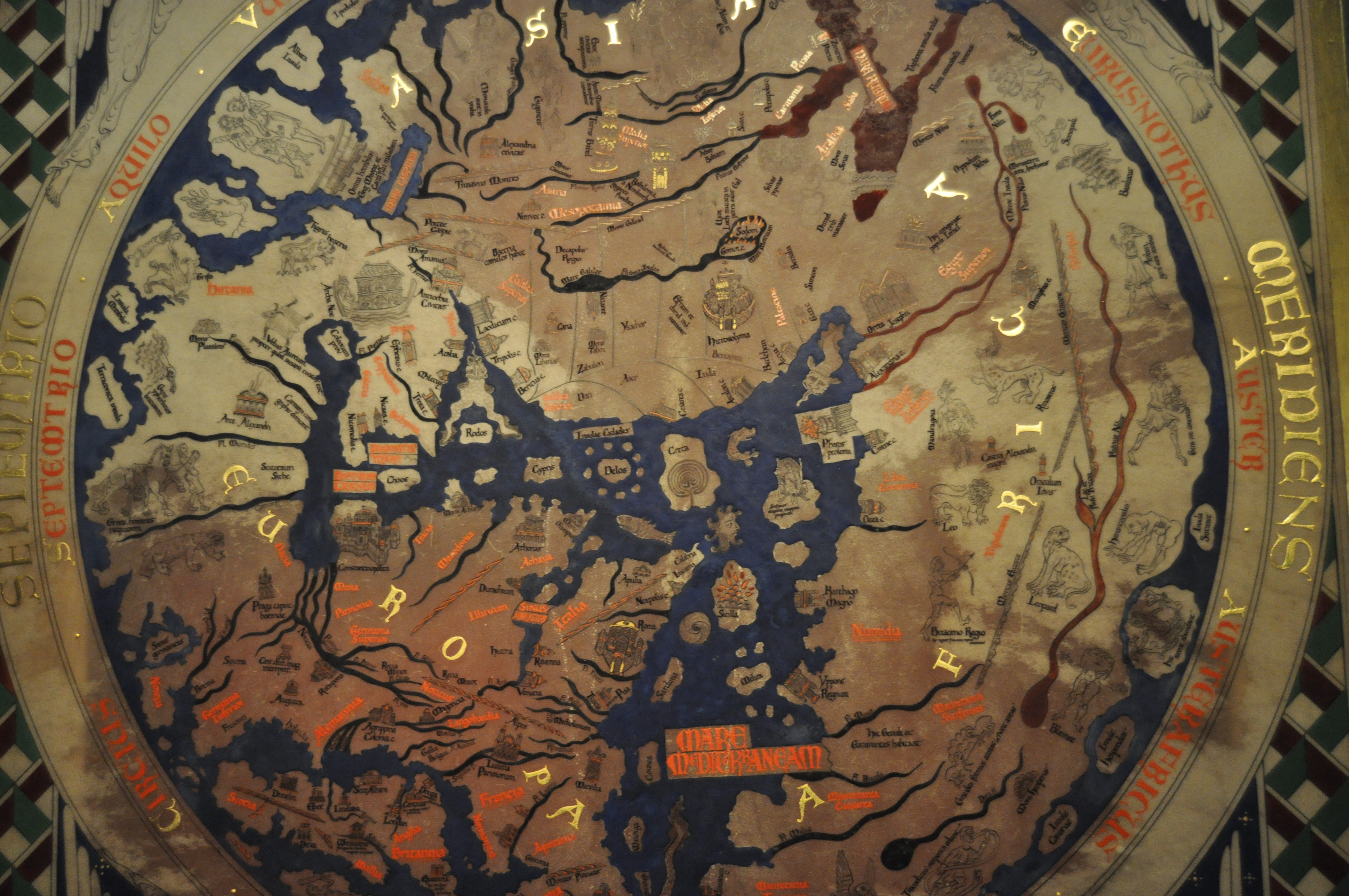
This map is new. It was commissioned by the people who have renovated the castle, English Heritage. It is called the Mappa Mundi.
Expert calligraphers were called in to synthesise two existing maps: the only surviving 12th century one from Sawley, which now lives at Corpus Christi College, Cambridge, and the famous Hereford Mappa Mundi of the 13th century.
Phil the Very Important Historian is deeply sceptical. How can we interpret and recreate such a document at a distance of 800 years? He snorted with derision when I relayed what the guide had told me in the room where the map hung.
But by that time I had lost all sense of proportion. I was like someone who has been with a double glazing salesman all evening, and wants the lot, now. I had seen the Mappa Mundi and I had seen the light.
It was made with calfskin vellum, for petesakes, I argued as we drove home. They ground up lapis lazuli and malachite to paint it, they have lovingly dressed it with gold leaf. They ground oak galls for one pigment, I ranted; they even have something called Dragon’s Blood on it.
It was a thing of such breathtaking opulence and beauty, I would have defended its shady provenance in a duel. If women ever did such a thing.
And all the time this little voice was saying, Kate, in between Sawley and Hereford, and this louche smoking-jacket of a map: who changed things? And on what basis?
Oh, how a little lapis lazuli and gold leaf can go to a woman’s head.
But what was the motive for its creation? I can only hazard a guess at how big a slice of the £2.4 million renovation budget went into its making.
Dr Steven Brindle, the English Heritage historian behind the project, said of the map: “We wanted a spectacular and charismatic object that would convey as much as possible about 12th Century culture, about how different the medieval views of geography and spirituality were from our own.”
Most of us listen to the second bit, the bit about how it shows important views of mediaeval English culture.
But listen carefully. They wanted something spectacular and charismatic: a piece which drops jaws on site. This was a piece designed to engender respect. It accorded kudos to its owner.
Of course, playing for kudos – in its oldest, greek sense, can be a touch-and-go business.
When I was in my mid teens, I acted in a piece of Shakespeare. I played a man who wanted the admiration of his peers so very badly.
I was at a convent, and there were no boys. It was a polar opposite to Shakespeare’s No Girls ethic. We were performing Twelfth Night, and anyone who knows Malvolio and I will howl with mirth at the apt casting.
Malvolio is simply the butler, or head steward. He looks after the house of the beautiful – and recently widowed- Lady Olivia. And with an innate pomposity, he makes enemies where enemies should not be made.
He is good at his job, but his Achilles heel is this: he feels secretly entitled to honour, glory, and acclaim.
And when he makes an enemy of Olivia’s quick witted maid, she uses his yearning for status – for the kudos of a household and a beautiful and distinguished wife- to tie him up in knots.
The letter she writes, pretending to be her mistress, reminds our foolish friend: “Some are born great; some achieve greatness; and some have greatness thrust upon them.”
It all ends in tears, as you well know. Poor Malvolio, hoisted by his own need for someone spectacular and charismatic to bring him riches and borrowed glory.
Our small nation has used kudos more than most. The posturing of its great castles has sent an important message or two over the centuries.
Today, even illustrious organisations like English Heritage are not above the same posturing to bring a project they have nurtured glory and honour, even if the provenance requires close scrutiny.
But under Shakespeare’s puppet-strings, our cross-gartered, yellow stockinged friend shows there will always be those who try, however comically, to borrow greatness from someone, or something else.
And in doing so, they leave us an opulent legacy.
 Kate Shrewsday
louche smoking-jacket of a map… bwahaha!
But I do lust for that map …
You seem to be having a charmed break, I’m glad 🙂
Cindy, if maps had characters, this would be Byronian. It is one of the most flamboyant maps of all time. I’m going back tomorrow to drool shamelessly. Thanks for those lovely words. Lets hope the weather holds…..
Did you happen to see the Magnificent Maps exhibition at the British Library this summer? It showed how maps were created as symbols of power, as well as works of art, and how they have been used as propaganda for centuries – it was fascinating.
I didn’t catch it- I did however see the accompanying TV series. Amazing stuff, I am a total map freak. Have you checked out old city of London maps? There’a a fabulous site which has the peerless Newcourt map on it in sections. Delicious. I had better stop now or I may become a cartographic bore….
Cheers James:-)
I adore maps, could spend hours pouring over them and often do.
Love the photographs, but they make me homesick. For someone who has been all over the world in the past thirty years that should be nonsense, yet it is true.
Glad you like them, sorry they cause an ache. It is always so hard having one’s heart in more than one place. We used to live in Kent and I cried the night we moved away. My heart longs for it when I am not here, even though I am only a couple of hours away.
I have just been catching up on your blog and what a delightful read 😉
Thank you for taking me on your walks.
You are more than welcome, Tokeloshe. I always enjoy going on yours!