Felix says his lucky number is 13.
He feels the whole unlucky thing is simply Americanism gone mad. He says 13 makes him feel at home.
That would explain a lot.
Maddie has a penchant for 21. At first she says it is the age where one can have a lot of independence. Then she changes her mind, and says it’s lilting and it sounds nice and musical.
Phil and I like thirty nine.
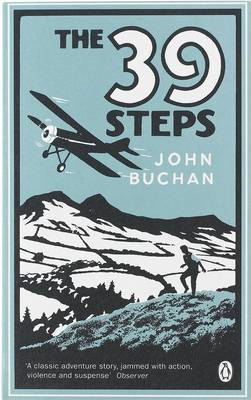
Because about six months ago, we discovered John Buchan’s The Thirty Nine Steps.
This is a vodka martini of a book: an action-hero’s tale written in 1915, just before the first world war robbed us of an innocence we never recognised until it was gone.
Its hero, Richard Hannay, has made all his money in South Africa, and relocated to London for a sparkling social life which never materialises.
Suddenly he finds an existence of dinner parties and matchmaking hostesses unbearably stultifying.
He is on the brink of turning round and going straight back to SA again, when a rum gentleman turns up on his doorstep and begs for sanctuary.
Invited in, he makes one of the greatest surprise confessions I have heard in any novel. he tells Hannay: “You see, I happen at this moment to be dead.”
Hannay is a bored, thwarted adventurer, and he finds that instead of dreading the cataclysmic series of events which are remorselessly set in motion by this confession, he is exhilarated and refreshed by what tumbles into his life.
He never wallows in a moment of misfortune: quick witted and not over-complicated, he looks for the exit, and through sheer grit and clever determination, he wins through. I’m not sure this book is a tumbler of whisky, so much as a glass of freezing-cold Scottish mountain spring water.
And here we sit, this week, on the same coast where Buchan wrote his classic.
So, we reasoned, somewhere near here – must be those illusive Thirty Nine Steps.
Hannay himself has a job locating these. The man who happened at that moment to be dead is subsequently stabbed through the heart a few days later, leaving a notebook with details of a spy’s departure.
But the details are sketchy: Thirty nine steps: High tide, 10:17.
With diamond-clear reasoning, and a local coastguard’s sound experience, Hannay tracks the steps down to a point on the south coast which sports both these characteristics on a certain day. It is the scene for the climax of the perfectly plotted book.
Consequently, any set of steps we find at the moment, leading down to the sea, render one of our number silent.
The children will caper happily down, and I will chatter and laugh with them, and Phil will be totally silent, preoccupied with an inner monitoring exercise.
Yesterday, we reached the bottom of the steps nearest our house and he broke silence. “Thirty Nine!” he exclaimed triumphantly.
I was impressed. And a little bit elated. “Thirty nine steps? “I inquired incredulously. “Really? You’re not joking?”
His lopsided grin joined his shoulders in a placatory shrug. “Well….Forty two. Almost right.”
We are still looking.
The innocence of Hannay’s time was soon replaced by untold horrors. But that restlessness, that need for something out of the ordinary to happen: that is a thread throughout this century’s great war poetry.
And nowhere is it more evident than in the poetry of the pilots who defended our shores.
The two that can move me to tears are not British pilots. They were, essentially, fighting someone else’s war.
The first is an American who died at the age of 19. John Magee enlisted, aged 18, through the Canadian Air Force to join the Battle of Britain.
On September 3 1941 he climbed in his spitfire to 30,000 feet. And while he was up there he had an experience which gave birth to a poem. It writes of dancing the skies, chasing the shouting wind and flinging his little plane through halls of air. It is ecstasy in words.
I have this deep-seated feeling that peace time could not have spawned such a poem. These men lived on the knife-edge between life and death. They chose this risk, because it led to heights the rest of us could never dream of.
The second pilot’s words were written by one of my all-time great favourites, WB Yeats, about a first World War pilot, Major Robert Gregory.
In it, he gives his old friend words. Those that he fights, he does not hate; those that he guards he does not love. He tells us:
A lonely impulse of delight
Drove to this tumult in the clouds;
I balanced all, brought all to mind,
The years to come seemed waste of breath,
A waste of breath the years behind
In balance with this life, this death.
At lunchtime today the weather turned. By three, it was officially raining torrentially.
I took the dog, put on his lead, picked up the brolly and headed out into the teeth of the gale.
“Are you sure the umbrella will stand it?” called Phil after me, and I said Yes, of course it was, this wasn’t Force 12, for petessake.
I made it to the top of the clifftop steps- about one minute away- before the big black beast of a brolly was inside out.
The dog and I headed down the cliff, buffeted by wind and slapped by raindrops. the sea roared, and I threw all plans to the wind, and soon both the dog and I were laughing out loud. This was extreme. And rather liberating.
On the beach a solitary dog walker skulked under the arches and threw balls. His doolally black labrador, tongue lolling in helpless adoration at the storm’s style, dashed following ball after ball.
We arrived back home drenched and delighted. The spectre of the mundane had been banished. Adversity had whipped us both into a better frame of mind, and we were jovial.
Every pearl needs sand to achieve perfection. And I wonder if humans need adversity. For adversity we must drop everything, and handle the extraordinary, whatever the cost.
Hannay was liberated by a man who declared he was dead. Our pilots found the knife-edge danger of wartime flight peerless: many never found its equal again.
And maybe every now and then, we are required to drop everything to face adversity: a gale, or a power cut, or a snow fall.
Who knows when we will be asked to side-step the mundane?
For reference:
An Irish Airman Foresees His Death
I know that I shall meet my fate
Somewhere among the clouds above;
Those that I fight I do not hate,
Those that I guard I do not love;
My country is Kiltartan Cross,
My countrymen Kiltartan’s poor,
No likely end could bring them loss
Or leave them happier than before.
Nor law, nor duty bade me fight,
Nor public men, nor cheering crowds,
A lonely impulse of delight
Drove to this tumult in the clouds;
I balanced all, brought all to mind,
The years to come seemed waste of breath,
A waste of breath the years behind
In balance with this life, this death.
— William Butler Yeats, 1919
High FlightOh! I have slipped the surly bonds of Earth Up, up the long, delirious burning blue — John Gillespie Magee, Jr |
 Kate Shrewsday
Magic!
By the way – never mind 39! The Answer is 42!
Ah, yes, but what is the question?
Ah, the desire to break the mundane and live in pure adventure- I love it. Except if it’s too hard. Then the mundane doesn’t seem so bad to me. Oh, can I ever be satisfied!?
LOL I know exactly what you mean, Zoe. I feel the same way.
Ahhhh Kate, this is a winner. Thank you thank you for describing the ecstatic nature of danger and wild weather. I experience that too. The edge of danger is life affirming.
And adversity CAN bring communities together. I love an axiom I learned in Sociology – that former enemies become friends when an adversary greater than either arrives on the scene. That’s one of the reasons I’m happy to be alive during these “perilous planetary times.” A great catalyst for global cooperation.
Thank you for the poetry, too, and your beautiful description of laughing in the face of the torrent.
Glad it struck a chord, Deborah:-)
Buchan wrote the book while he was recuperating from illness at a house called St Cuby, Cliff Promenade, Broadstairs. The original steps were demolished, and a part of them were sent to Buchan. They were replaced by concrete, and this set of steps still runs from the garden to the beach.
But tell Phil that 42 is a really lovely number …
I loved reading this, Kate.
I might have known you would have our location, Cindy, and I love the fact that Buchan was sent part of the original steps. Thank you! I feel an expedition coming on…
Now I will have to reread The Thirty Nine Steps. I haven’t read it since childhood, but remember it held me through to the end.
And thank you for the poems, and especially laughing in the face of the storm. It delights me to be out in heavy rain – all wrapped up, of course. Though many times I have returned home soaked to the skin; and loved it!
It’s a wonderfully uncomplicated read. No string attached. Nothing like a storm, is there? And by the sea it’s peerless:-)
i enjoy your world…
you’re a word seamstress – the way you’re able to crochet so much in such little space.
Thanks UE, I love yours too:-D I use a lot more space than you do though.
Nothing like trudging through stormy weather to wake us up a bit!
BTW: I’m with Felix . . . 13!!!
😀 A good storm generally blows the wind through the sails..