I am having a ball during story time right now.
I adore reading stories out loud, especially really good ones. I am loud and demonstrative and bawling and actressy. I read as I find: because language exists to be spoken.
So story time has always been a treat, for me as much as for the kids.
I have discovered anarchic youngsters’ literature like the peerless Winnie The Witch, in which Valerie Thomas sums up my life in a few well chosen words and Korky Paul paints me in a number of pleasing poses.
As the children grew older I turned to the classics: we have read The Railway Children, Narnian Chronicles, modern gems like I, Coriander, by Sally Gardner, and Smith, by Leon Garfield, and all those wonderful Unfortunate Events which Lemony Snicket relates so very well.
All three of us fell in love with Cressida Cowell’s beautifuly written bawdy brilliance. Reading those old Norse legends re-worked for a seven year old showed me our endless ability to reinvent and retell tales which go back thousands of years.
These stories are all best spoken out loud. Storytelling is an art which stretches back for millennia. It is aural: we hear it in our heads. It is the rhythmic rise and fall of speech as it should be spoken.
The other day Maddie thrust a book in my hand to read at bedtime. I have avoided it for, ooooh, maybe three years, because it had Trouble written all over it.
But when I finally gave in, I realised that this slim volume was my Green Eggs and Ham. It was entitled “You’re a Bad Man Mr Gumm”, and it was by a man called Andy Stanton.
Stanton studied English at Oxford, but as he puts it so succinctly, they kicked him out. Among his jobs he has held his own as a stand-up comedian. His favourite expression is Good Evening, and his favourite word is Captain.
And the man is a genius. In every sentence lurks a surprise, there’s a twist round every corner, and each book is a romp of such proportions I find it almost impossible to stop reading him out loud. Every sentence inspires admiration verging on the envious.
My ambition is to read his words out loud to at least 200 children, all at once. And I shall, I shall.
Describing him is impossible: only reading his work can bash you over the head with that silver kipper you so desire.
So I’ll just give you the opening paragraph of his opening volume.
“Mr Gumm was a fierce old man with a red beard and two bloodshot eyes that stared out at you like an octopus curled up in a bad cave.
“He was a complete horror who hated children, animals, fun and corn on the cob. What he liked was snoozing in bed all day, being lonely and scowling at things.”
Every night I am first in the stampede to get the book, and the children are going to bed late because I can’t stop reading, it is just so darn funny.
God knows what the neighbours are making of it all. I do all the voices from the little village of Lamonic Bibber, where the action takes place.
What is extraordinary is how Stanton controls the pace and rhythm of his writing so perfectly. It’s a madcap, breathtaking pace suited exactly to comedy. Every reading begins to seem very much like a one-woman-show.
The way we use adjectives and similes and metaphors and adverbs is vital; but I can’t help wondering if all these mean nothing, if they are not framed in the rhythm of spoken language.
But man cannot live on Mr Gumm alone.
On my bedside shelf is a book which was thought to have caused two earthquake shocks which hit London just after its publication in 1749.
Apparently the earthquakes were the result of Henry Fielding’s wickedness.
As Hogarth drew, Fielding wrote, and Tom Jones is an earthy examination of the baser side of human nature.
It follows Jones from his questionable birth and adoption by a local member of the gentry, though a series of bawdy adventures, until he is finally rescued and redeemed by the love of a good woman.
It is base, really it is. But oh, what a storyteller that Mr Fielding is. His work is a rumbustious outspoken speaking-out, and it is never more mischievous and impish than when read out loud.
Stories, they are meant to be heard. I overuse semicolons precisely because of the rise and fall of speech in Fielding’s storytelling. He knows when to suspend, when to draw to a close; when to state simply, and when to draw his listener along lanes and alleyways before his sentence reaches a conclusion.
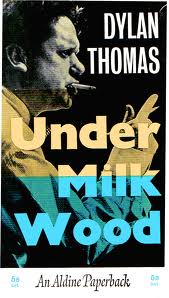
But for me, the master of us all, when it comes to the rise and fall of speech, is Dylan Thomas.
I will never forget the first time I listened to Under Milk Wood. It was like coming home. Here was a man’s unflinching, affectionate, haunting account of life in a small village.
But it isn’t an account, is it? It is so much vaster than that, a landscape of the unspoken. Thomas conjures up wonder at the tiny beloved minutiae of lives in a seaside town, using the rocking to and fro of the gentlest of speech.
His words flow like music. They are poetry in motion, and they make me humble:
“Only you can hear the houses sleeping in the street in the slow deep salt and silent black, bandaged night. Only you can see, in the blinded bedrooms, the combs and petticoats over the chairs, the jugs and basins, the glasses of teeth, Thou Shalt Not on the wall, and the yellowing dickybird-watching pictures of the dead.
“Only you can hear and see, behind the eyes of the sleepers, the movements and countries and mazes and colours and dismays and rainbows and tunes and wishes and flight and fall and despairs and big seas of their dreams.”
The very words make me want to rush out and give the King’s shilling to enough people to form a cast, and read it from beginning to end.
Ah, spoken language is lilting, not just in English but in any language. Because between the lines, somewhere in among those sound waves, is a wealth of meaning waiting to be heard.
 Kate Shrewsday
Kate, my feelings of worry and guilt spread rapidly as I read today’s blog. You fill your children’s lives with amazing literature, and what book did I buy Felix last week? Captain Underpants! May I apologise in advance of that book being started and suggest that maybe Felix should read that one to himself! 🙂
LOL I’ve just been ordered to get the sequel to your gift, Nix, entitled Captain Underpants and the Attack of the Talking Toilets.
Beautiful, Kate.
Cheers James:-)
Oh, this is just what I needed on a tired, late Sunday afternoon. You have touched on some favorites, but, I am sorry to say, I have not read (either silently or out loud) Under Milk Wood and now must find it. Tom Jones in high school English Literature many long moons ago. A re-reading soon, but, first I must finish Ballet Shoes.
Ah, a Gum with one ‘m’:-) Do you know I have never read it to Maddie and Felix? Must do that!
Under Milk Wood needs to be listened to, preferably with Richard Burton in the lead storytelling role, should be on itunes somewhere. I envy you that first listening…
bash you over the head with that silver kipper …
I am STEALING that!!!
It’s a gift….or maybe the very act of theft makes it more piquant….
Kate, I’ll be at your house for storytime! It’s absolutely my favorite time of day. Although my boys are getting bigger (8, 11, 14), they still enjoy it when I read to them. In fact, this summer on our way home from holiday, I ready the entire plane ride to the two oldest and knocked out some of their summer required reading. I’m certain to go look for old Mr. Gumm this week.
Oh, do, Tammy, you’ll have such a treat:-) Lovely to hear your boys still get their read. And what a brilliant way to pass a plane ride!
Has you ever read the original ‘The Tale of the Land of Green Ginger’?
I haven’t.
But it was recommended to me with such glee and enthusiasm that I spent a long while trying to track one down, even though my boys would probably be far too old for it, seven then. “It is no good,” my friend said, “reading the more recently released version; you need to read the original.”
A review here http://www.dooyoo.co.uk/junior-book/the-land-of-green-ginger-noel-langley/1004909/#rev seems to echo that.
Your account of “You’re a Bad Man Mr Gumm” imposes the same imperative: this is a book which must be read, aloud, to an appreciative audience.
How did your lot respond to Mr Majeika
http://en.wikipedia.org/wiki/Mr_Majeika
Sometimes this was ‘tea time reading’ (when everyone is a little bit tired and fractious a story at tea time instead of bedtime seemed to work) and we laughed so much… but maybe a little too young for your children… not sure of their ages.
Teatime reading sounds a brilliant idea. May nick that one. Never tried Mr Majeika, Dustin Hoffman put me off, but after answering you I’ll get on to Amazon and order a copy:-) Along with a slightly cheaper copy of The Tale of The Land of Green Ginger….thanks Pseu…
This copy
http://www.fantasticfiction.co.uk/l/noel-langley/tale-of-land-of-green-ginger.htm
is priced at £2864.89!!!!
Erk!!
I love Under Milkwood. And you’re right you really need to hear it or speak it, not just read it. It’s extra special to me cos Michael and I saw a production of it in Leeds on our first date. I still remember how uncomfortable the chairs in the theatre were. Somehow we managed to start holding hands early in the second half…
I’m not surprised…what a wonderful way to woo.
I liked Tom Jones but loved Pamela: running upstairs, running downstairs, fainting at just the right moment. We weren’t supposed to laugh, but my entire novels class, including the professor, had such fun watching Pamela preserve her virtue. I’ve read little of Thomas, but you’ve made Under Milk Wood required reading. And Mr. Gumm. Thank you.
PS The new visage is striking. I’m moving from envy to covetousness. I want a change.
Pamela is such a treat, I so agree, Kathy. What Fielding didn’t say was so much louder than the words on the page:-) Glad you like the theme. Phil and I are having a battle with an image which is supposed to go next to the little welcome message. We will prevail.