I have become an outspoken soul in my day-to-day life. Words which once might have remained filed in my head seem to acquire an independent life and break free of their own accord.
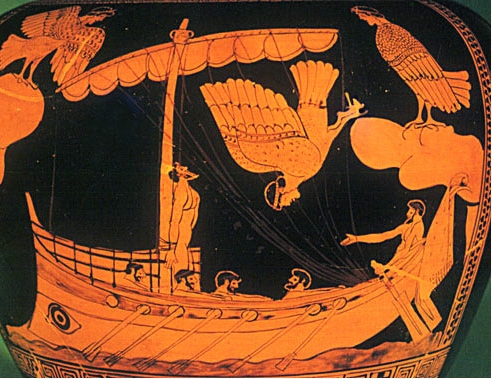
And as I implore my friends to stop my excess; to administer a swift kick to my shins, or supply me with sticking plaster- I am reminded of Odysseus, implacably drawn to the haunting music of an island race.
You all know the story: how the Greek warrior-leader’s ship was set to sail past the island of the sirens, those silver-voiced creatures who carried a sting in the tail.
Their beaches were strewn with the bones of those who had heard their music and swum to shore, the better to hear. And there they met a gruesome end.
Odysseus and his men were counselled to fill their ears with wax, so they might sail safely by and keep their bones intact.
But Odysseus knew that here was a moment in life which must be experienced. I must seize the day, he said, I must hear what no man has heard and lived.
He ordered his men to lash him to the mast of his ship, and gave instructions that no matter how he pleaded, they were not to release him.
It happened just as he had planned. He made an almighty exhibition of himself, lashed to that great tree trunk, ranting to be let free to throw himself to his doom. But he heard the music, and he lived to tell the tale.
Those of us who live to extremes recognise this story deep in their bones.
Many of us have our sirens, whose music would have us in their thrall. My sirens urge me to speak out, whatever the cost, when faced with injustice, insensitivity and plain idiocy.
And the cost of swimming to shore is as great as it ever was.
Because rash gestures such as this are not politic. One should consider before one speaks, and often one should simply not speak at all, says our very British ethic.
Shakespeare’s Cordelia whispers this island’s truism to herself before she speaks her mind plainly to her father, King Lear. What shall Cordelia speak? she asks herself in an anguished aside. Love, and be silent.
Lash me to the mast.
It does not help her case that her two elder sisters are honey-tongued, caring little for the cost and weight of truthful words. They have their eye on a third of a kingdom.
Finally, after much agitating from her father, she speaks plainly and impolitically. Yes, she loves her father, and she owes him much. But her love for him is not all-consuming, and nor should it be. One day, she argues, she will find a husband and owe half her loyalty to him.
And in speaking plainly, she creates a chasm between herself, and a vast kingdom. And indeed, she deprives herself of her father’s protection.
Not only that, but the foolish king loses the only daughter who would protect and love him with integrity. Lose-lose.
The sirens get their gruesome fare.
It is a long time since I last visited my favourite, impolitic fair.
Thackeray’s Vanity Fair is such a haunt of mine I have to guard against taking you for a walk there every post. All human life is there, and very little of it elevated.
One of Thackeray’s chief puppets is Becky Sharp. She is all I love and all I hate; ingenious and merciless, charismatic and cold, resourceful and resilient.
This morning as I considered the day ahead, I thought carefully about what actions and words I might employ to be politic.
But as my thoughts skated the surface, an impolitic subconscious monologue raged beneath, and I was ambushed by a vivid picture of what Becky Sharp did with a revered book.
It is the opening scene of the Fair, and Becky is leaving the school where she has been used as an articled pupil.
She has no illusions about the quality of the staff, and delights in taking her leave of the provincial principal in fluent French, knowing that Miss Pinkerton cannot speak a word.
Every pupil is given a leaving gift as they depart: a copy of the revered Dr Johnson’s dictionary.
Becky is not offered one. But the timid second-in-command at the academy takes pity on her, and places one in her hands as she alights the carriage to leave.
As the carriage clatters away for the last time, the window opens and the dictionary is flung out, back towards the scandalised schoolmistresses, in the face of all who have used her extraordinary skills as a source of cheap labour.
The incident opens Thackeray’s romp with such energy one is simply bowled into the Fair, without ceremony, at breakneck speed.
At least once in our lives, haven’t we all wanted to do that: make an unequivocal gesture which speaks quite plainly of how we feel?
But Becky is more politic than most. Her gesture is carefully timed, and her knowledge of human nature seems flawless.
The people she has scandalised are not clever enough to be significant, and not likely to affect her future.
What is lacking in Becky is Odysseus’s edict. She does not need to be lashed to the mast. She has ceased to care.
The sirens have to wait a long time for this one. Becky climbs and climbs, courting celebrity and scandal, listening to their haunting music.
But they get her in the end.
So it seems to me that the sirens are not choosy. The need to speak out, or act, when it is not politically astute to do so: it tugs at honourable and dishonourable, greatest and least.
For my part, I shall continue to recruit those I love and respect to test their knot-tying skills, lashing me to the proverbial mast.
Because the cost of being impolitic is far in excess of that unassuming little word which clothes the concept. Once that dictionary has been flung out it cannot be taken back.
There will always be times we must play Cordelia, and speak out because integrity demands it.
The wisdom comes in distinguishing those times from all those legion others.
 Kate Shrewsday
Oh what a well-written piece, Kate! I, too, struggle to keep my tongue silent. Most times I succeed, but when I don’t, I usually end up in trouble.
Trouble is my middle name James:-). Siren fodder.
beautifully written Kate.
“Lash me to the mast” is a fun sentence to say.
LOL I did think about that as I wrote it…but I concluded there’s no other way to say this, dual entendre or not.
Comment number two!! Impressive!!
You can imagine my disappointment when I first saw the historical depiction of the Sirens. My teacher had described them as this penultimate source of beauty (in sound at least) and I extrapolated to physical beauty as well. Guess I’ll just throw anchor at the Island of Lesbos (or Lotus-Eaters!).
There is such a fine balance between saying what you want, saying what you should, and saying what is everyone else knows you shouldn’t say but you don’t (the latter is my roommate). I’ve confused myself.
But I understand exactly what you mean:-) and it’s such a perceptive comment. Your flat mate makes me laugh though- we all know someone like that!
Another thought-provoking post. You know my name is really Penelope and I love to tell people I am the long-suffering kind, as in Odysseus’ Penelope. Ah well, my problem is tempering my speech when saying what I should say. “lash me to the mast” – I must remember that one.
Penelope did wait a very long time indeed, did’t she? Long-suffering is the word!
And tempering the speech- that is another on my long list of to-dos:-) Thanks Penny.Your grandfather, by the way, is really very beautiful.
Oh this was a marvelous read, I’ve been known to open my mouth to change feet. lash me to the mast!
“I think I could be a good woman if I had five thousand a year.”
The number of times I have watched someone picking the dead leaves off geraniums and fought those words from my head….
Yet, sometimes those words do need to be blurted out.
The Emporor indeed has no clothes…
LOL You are so right, Zoe.
“To blurt or not to blurt, that is the question.”
I admire those who speak their minds spontaneously, so to speak, without allowing the filter to click in. I have many times had words on the tip of my tongue, but left them unspoken and regretted it, as once the moment has passed often the moment is lost.
On the other hand I can also admire those who wait and consider their options and approach from another angle.
I have a friend on each side of this balance and I sit pretty much in the middle of it.
A very good place to be:-) I think wisdom sits somewhere in the middle.
Brilliant post, and comments, Kate! I too have that somewhat Saggitarian affliction of foot in mouth…
Amazing how many writers do, Naomi:-) Perhaps, for us, this represents a place we can really consider what we say before it makes its way out into the world.Thanks for those lovely words.
Thank you. Now, instead of “Kick me,” I can say, “Lash me to the mast.” Much classier.
It does have a certain ring to it, doesn’t it?