There are more ways than one to get things done.
If one wants to detect an enemy plane in time of war, one can stand on a high hill and simply watch.
Or, as at one of my favourite haunts in Dungeness, Kent, one can station great concrete ear trumpets on the beach, to listen for the hum of the enemy.
Built between 1928 and 1930, these incongruous structures are acoustic mirrors which were built as an experimental early warning system. They are there because it is one of the quietest places in Britain. If not there, then where?
But a third way superseded these great white elephants very soon after their creation. Because in the heart of the darkest days of the second world war, radar was born.
Radar was a name which first lived, in 1940, in capitals. It stood for Radio Detection and Ranging. It works by sending out radio waves in a straight line from a radar station. They meet a plane coming the other way and bounce back.
And what they can do is little short of miraculous.
They can determine not only that these things are there: but how fast they are going, which direction they are travelling in, and even their altitude.
What a wonderful invention. Even pilots could fly in the dark with knowledge of who else was about, long before they could see company.
Apocryphal tales are told of the propagandists making up a story to put the enemy off the scent of these miraculous powers the British pilots had acquired. It was put about that the pilots were being fed a diet rich in carrots, because carrots help one to see in the dark.
Radar was not, however, foolproof. Because while radar signals travel in straight lines, the earth’s surface is curved.
Which means that until we can invent intelligent radio waves which defy nature and make like a banana, the radar will start out fitting the earth’s surface snugly, and gradually move in a straight line away from the curve of the planet. Thus leaving a space underneath the radar for planes to remain invisible.
It has, these days, become a figure of speech: a way of talking about something which has characteristics which render it undetectable.
Today I have a headache, which forces one to take things a little more carefully than usual. I am living life with a little less gung-ho bravado, and a little more softly-softly caution. Life is grey: but I find I am noticing things which would usually be undetectable to me.
The rain, it raineth every day. Outside, the colours are muted.
This morning I walked across the iron age fort on the hill behind our house. The dog holds me personally responsible for the rain, and every now and then, as the wet seeps ever closer to the base of his tough wiry coat, he throws me a look of infinite reproach. Make it stop, he grumbles non-verbally. This is not acceptable.
But as I walked, I happened to glance towards a set of wiry birch trees with not a leaf to their frames. And there, a study in intricate oriental detail, nature had sketched a community of small birds silhouetted against the grey.
They were dynamic and ever-changing: someone was always moving from one branch to another, or flitting down for a puddle-bath. There must have been thirty tiny creatures, and I couldn’t see their colour in the gloom, only their shape.
A study in line and form, no-one said anything. The scene was set to the music of heavy ponderous raindrops, and it held an incredible, silent, charge.
My customary radar veers off before it picks up this kind of event, usually. Today, I was looking with different eyes, in a different place.
I came home and went out cybervisiting, paying my respects to friends and reading the stories of their daily preoccupations, just as once Jane Austen’s society paid less virtual respects to those in their sphere.
There is a new house I have been visiting, every day.
Its archivist is Barbara, and the one I visit – called simply ‘It’s About Time’ – posts works of art to contemplate, at least once a day. It is an art gallery from the comfort of one’s armchair: and it has a gifted director who makes a personal choice of art for you.
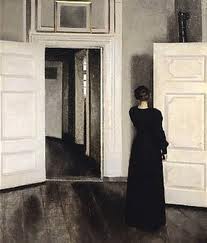
Today I stumbled upon work after work by a Danish man called Vilhelm Hammershoi. From the moment I set eyes on them, these paintings arrested my attention, there, in my muted world. For they, too, would have slipped beneath the radar on a normal day.
Hammershoi lived an existence which was far from being spectacular. He was born in the old quarter of the gracious city of Copenhagen. he stayed there and worked there all his life. His father was a rich merchant and so there was no garret struggle for financial security. His mother recognised his talent and fostered it from the age of eight. By the time he was in his mid teens he was studying in Copenhagen’s Royal Academy of Art.
His perfect, spare style captivated many who saw his work, and right from his first portrait out of art school he attracted acclaim. Famous artists flocked to meet him. He was shy and retiring.
He led a life rooted in one place, a muted existence. And as he lived, so he painted: with consummate taste, and perfect style and proportion. Not for Hammershoi brash primary colours: rather, muted scenes of moving depth, strong in form, minimalist before minimalism was a twinkle in the eye of the art world, often with a single figure turned away from the artist.
For 43 years this man and these startling paintings have slipped under my radar, because I love the brash and the bold. I wouldn’t have glanced in the direction of this spellbinding work.
It took a rainy day and a headache to slow me down enough to wonder at an artist’s muted style: and at the startling beauty of a tiny flock of birds.
When the headache is gone and the rain has ceased, I must remember this place, beneath the radar.
 Kate Shrewsday
Would not accept me to comment about the painting. I must really be underneath under the radar.
All the best people are, it seems, Carl 🙂
Peaceful, patient pictures.
I’m intrigued how many women he painted from behind…..
One of my favourite pictures is Vermeer’s ‘Girls with the Pearl Earring’ – and there is a Dutch similarity of style.
They are similar aren’t they? There’s a lot of thought that most of the women were his wife, a firebrand by all accounts. I love the picture he has painted of her in Barbara’s collection. Simply beautiful.
Kate, Thank you so much for your kind comments about my blog, It’s About Time. Barbara
Thank you for providing such a wonderful- and uplifting – resource, Barbara 🙂
You add more dimension to Hammershoi’s painting and life. I loved these pictures and needed to go back and look at them several times as I found more and more in their simplicity.
Ah, flying under the radar. So much is just there, waiting to be discovered.
I hope your headache gets better soon, Kate. I know how debilitating they can sometimes be. Rest.
Thanks for the heads-up about Barbara’s beautiful site, Penny – what a joy to have something new waiting there to broaden my horizons! One day, I have a feeling I might have to fill my house with Hammershoi. When I am living in the manner to which I would like to become accustomed 😀 And thank you, as I type the headache has forsaken its post. I’m quite glad. This one felt like a Samurai warrior.
Gorgeous post, Kate – your wordsmith skills are certainly not muted 🙂 I love the image of that flock of birds and can so relate to Macauley’s take on the rain – although it’s hot here, we’re inundated!
Hope your headache goes soon and you feel all better, xo
Thank you Naomi 🙂 I wish I had got a picture of those beautiful birds – but rain stopped play…
My headache is just clearing up now – thanks!
Hi Kate.
the most interesting thing about the carrots story is that, as I heard it, when the enemy heard the story, the German pilots were, from then on, fed a diet of carrots until they were sick of them or until the real reason for the extraordinary capability of the British pilots to spot enemy aircraft became known.
The great pity was that the reflective bowls would have been a great defence for the first world war, but were not produced until nearly the second!
How satisfying to find a way to fill the oppositon full of carrots 😀
Brilliant addition to our story, Dad, thank you.
How is the headache now?
It disappeared mid afternoon – I’m still at the suspicious stage though. Keep thinking it is going to pounce once more.
It’s rather odd that he painted so many faceless women . . . perhaps he never mastered the art of facial features. 🙂
Glad your headache dissipated. Samurai swordplay between the ears is trying, indeed.
That would be amusing indeed: “I can paint dresses all right, but a bit rocky on the faces….” His wife was quite a strong character: I wonder if the choice to be shown like that was hers? The form is striking agains the lines of his interiors.
Thanks Nancy. That was a lovely birthday piece you did today 🙂
Thanks. Illustrating it was great fun . . . scrolling through the archives on The Only Cin to pick a few favorites.
His technique and subject matter reminds me of Andrew Wyeth. Except for the portrait of his mother . . . that reminded me of Whistler.
The rain it raineth every day. I can see someone I think is Ben Kingsley singing it. But where, why, that image is unconnected to anything in my memory.
I love your meanders, always like a stream, taking our attention along a journey. Thanks
Ah yes, the fool in twelfth night.
Thanks Sidey 🙂 Ben Kingsley sings it at the end of the Twelfth Night film, I think. Love his fool.